

Thread
When knowledge disappears between projects, every team starts from scratch. Thread was a strategic research initiative to design an AI-powered platform that helps design teams create, trust, and reuse research - without losing the human judgment that makes it valuable
AI Strategy | Research Design | Systems Thinking
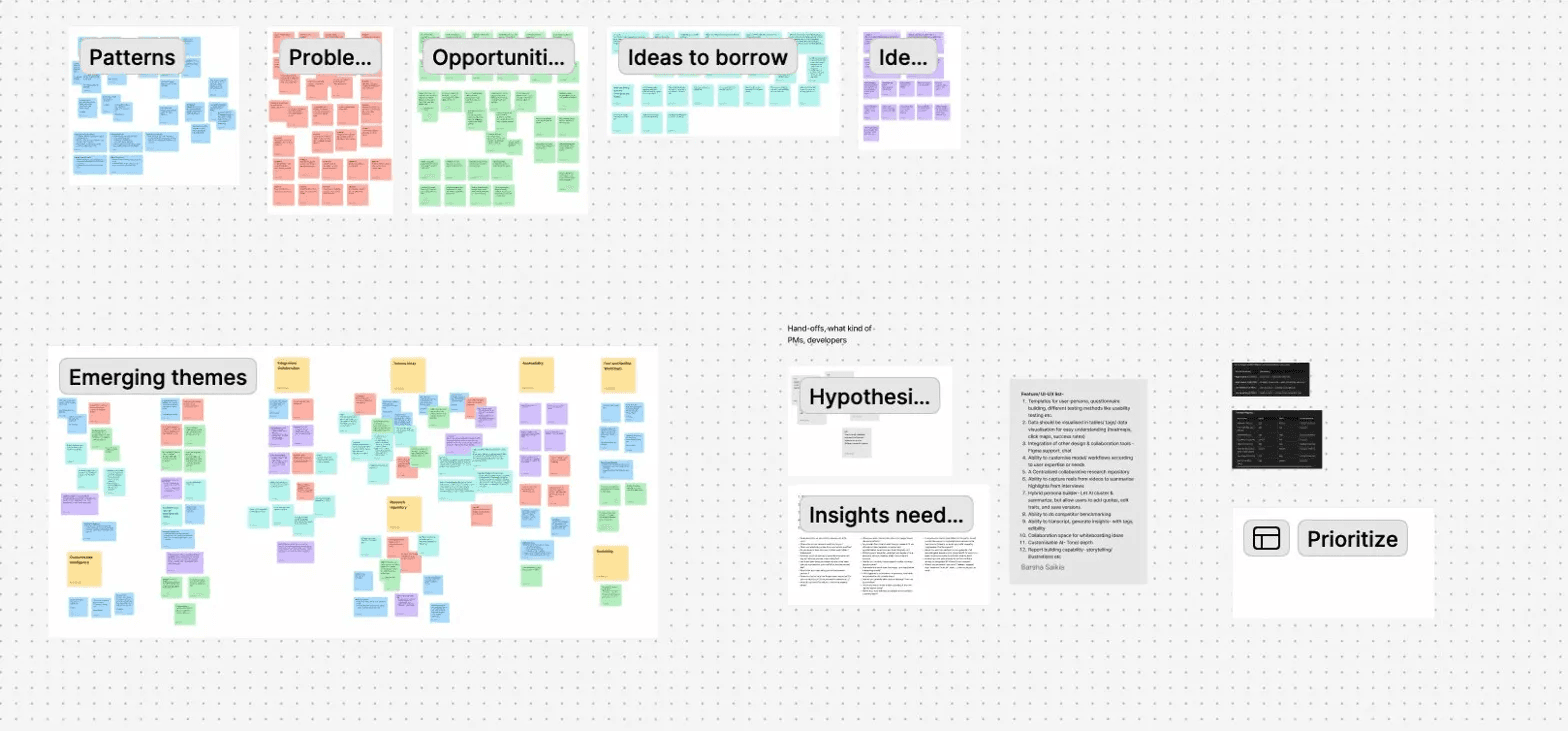
Project brief
✦ Project: Internal AI research platform for design teams
✦ My role: Research Lead - strategy, interviews, synthesis, personas, journey mapping, opportunity prioritisation.
✦ Team: Led with 2-3 other designers, inputs from senior leadership
✦Method: Landscape scan, survey (17 participants), semi-structured interviews (5-6 designers + 1 PM), co-creation sessions
✦Status: Research and strategy phase completed. Deprioritised due to organisational restructuring.
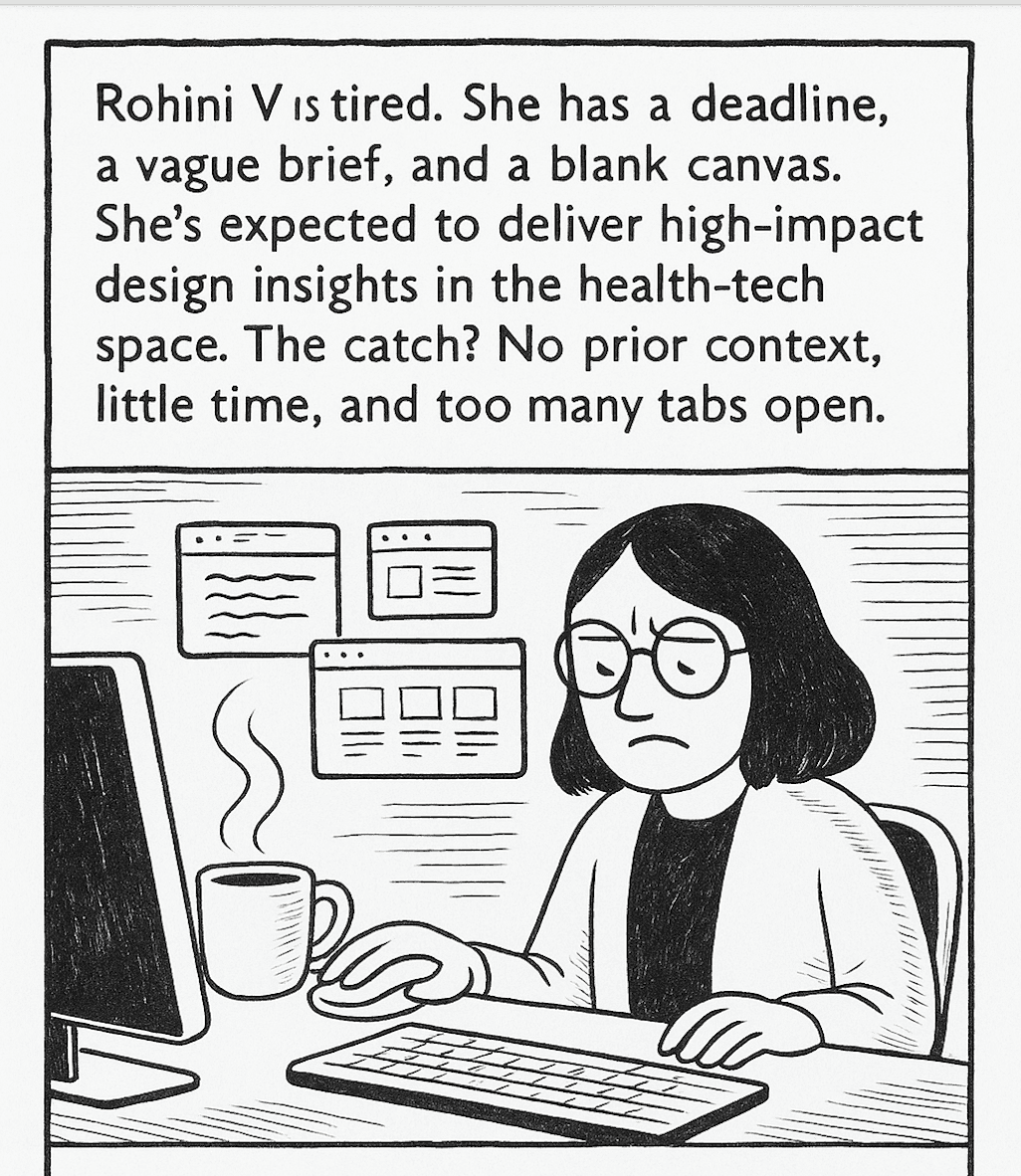
This wasn’t just about helping Rohini.
It was about supporting all those like her -designers, researchers, PMs -
expected to make sense of complexity without losing their minds (or Mondays).
The Problem Nobody Named
Design teams generate enormous amounts of research. Interviews, surveys, synthesis boards, insight decks, journey maps. But ask any designer where last quarter's research lives - and watch them pause.
The knowledge exists. It just doesn't accumulate.
Every project starts from scratch. Every new team member gets a fragmented handover. And every AI tool that promises to help creates a new problem - outputs nobody trusts, black boxes nobody can interrogate, automation that removes the human judgment that made the research valuable in the first place.
This was the gap Thread was designed to address.
RESEARCH APPROACH
How We Investigated It
Before speaking to anyone, we mapped the landscape.
Eight AI research platforms - Maze, Looppanel, Dovetail, Condens, Buildbetter.ai, Enjoy HQ, Kraeftful - evaluated across three analytical lenses: functional capability, interaction quality, and workflow integration.
We documented not just what these tools do but how they fail. The trust gaps. The collaboration limitations. The over-automation that strips nuance from research outputs.
One category-level truth emerged early:
No tool covers the full research lifecycle. The market splits between niche tools that do one thing well and broader platforms that do everything poorly.
The universal gap - across every tool studied - was transparency. Users couldn't trace how AI arrived at its conclusions.
This shaped every research question that followed.
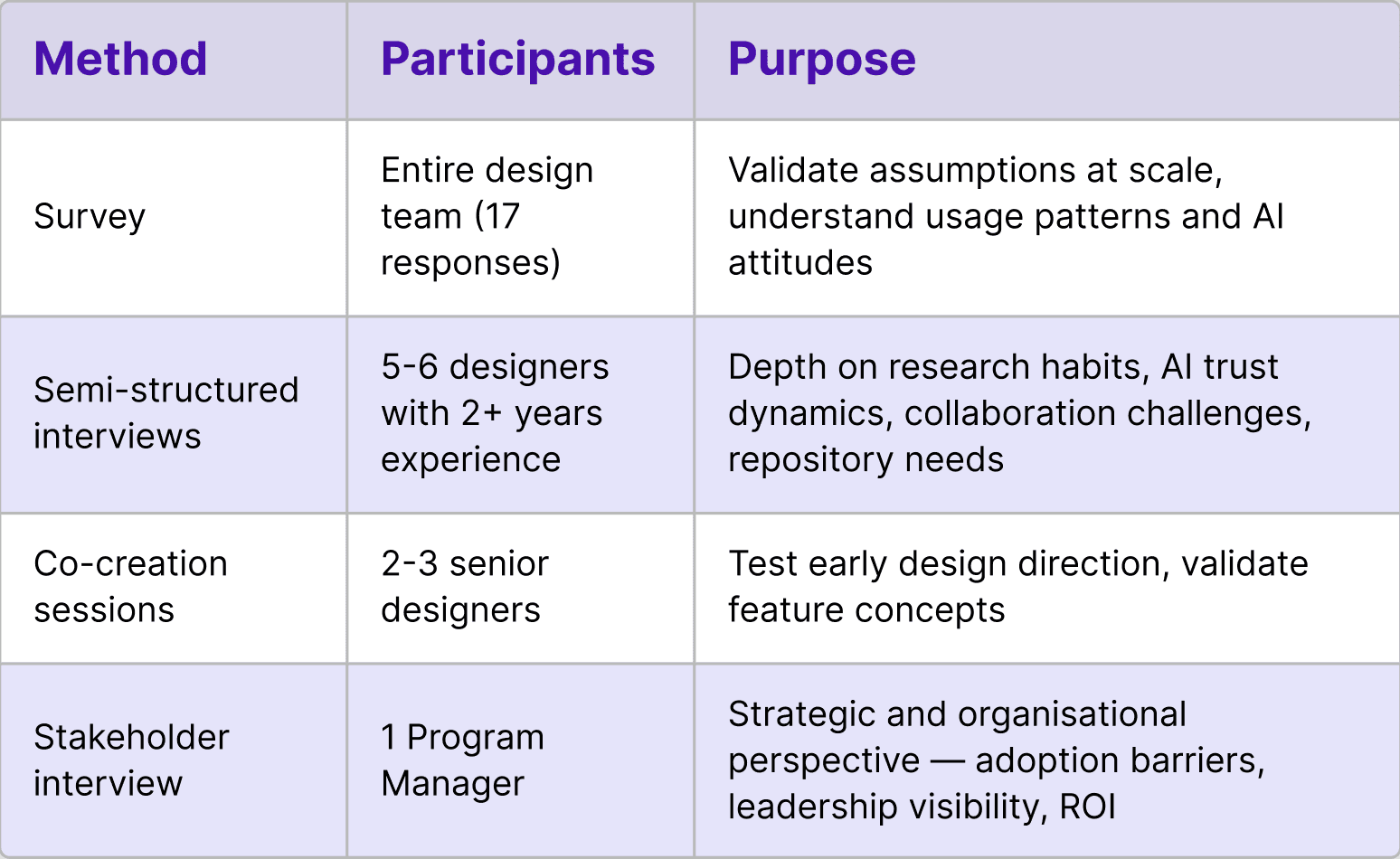


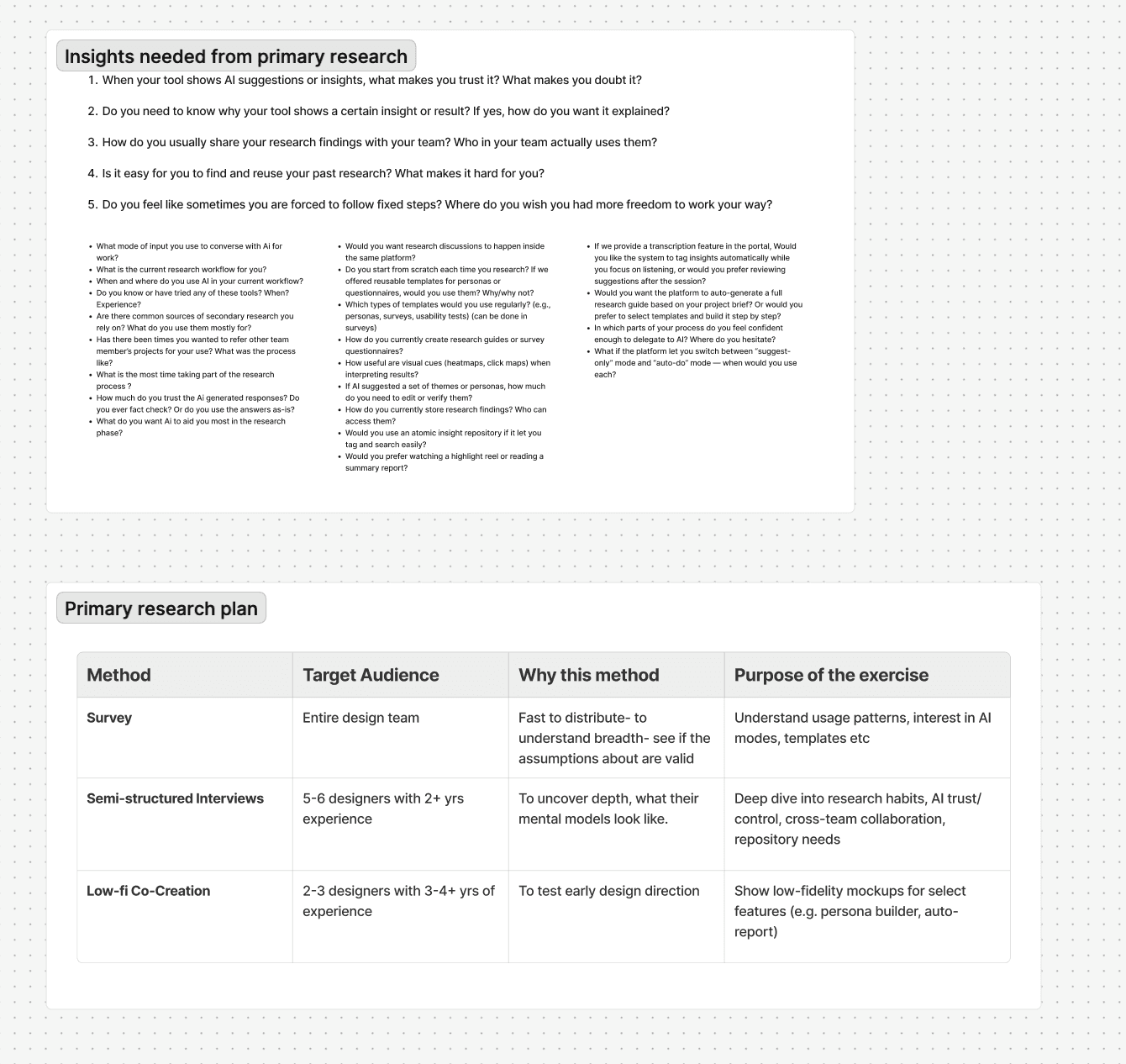
Before Talking to Anyone - What the Survey Revealed
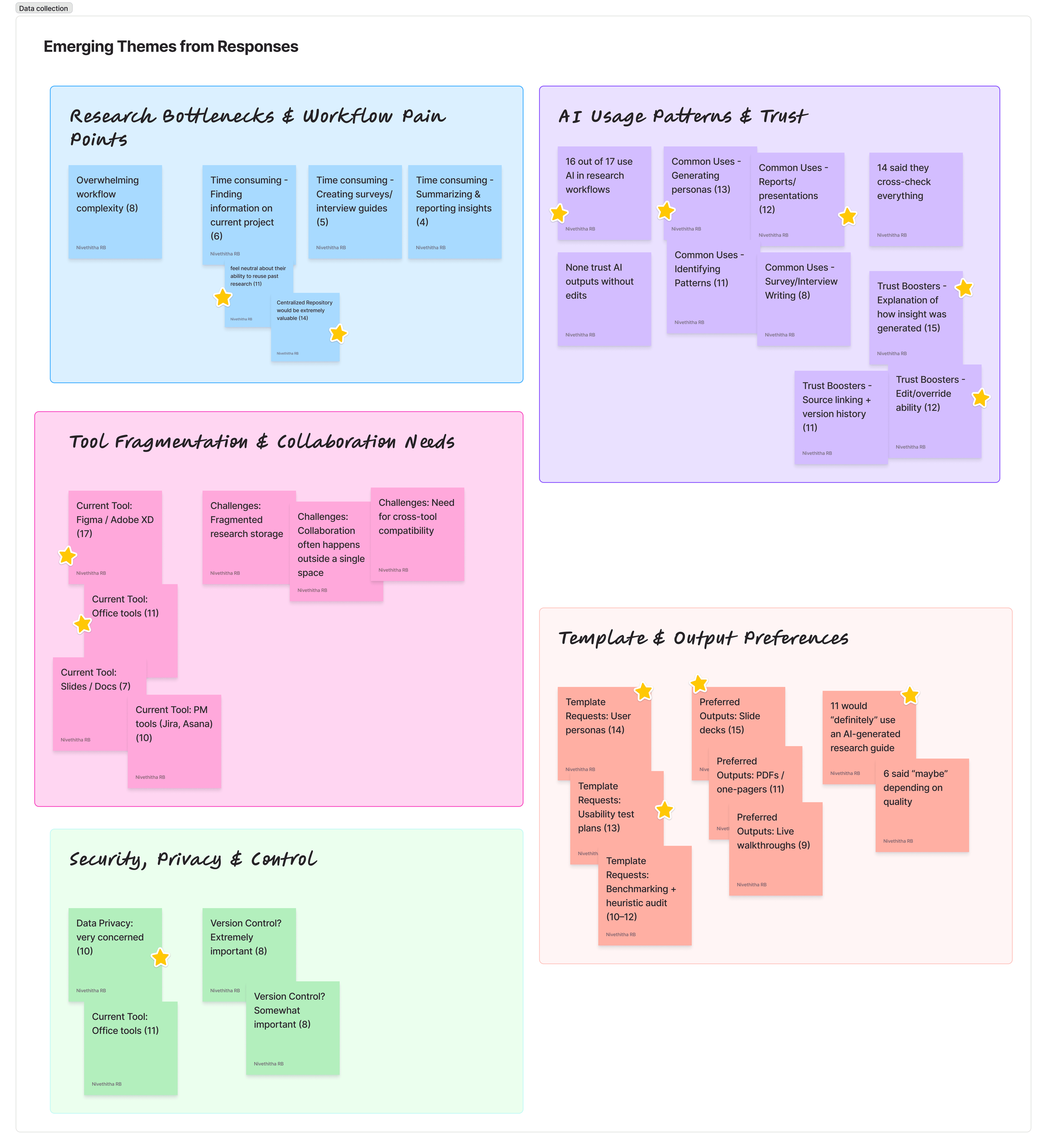
A survey distributed to the full design team gave us something qualitative research alone couldn't - scale and specificity. The numbers were striking.
16 out of 17 designers already use AI in their research workflows
0 out of 17 designers trust AI outputs without editing or verifying them first
15 designers said explanation of how an insight was generated would most increase their trust
14 said source linking and version history were critical trust boosters
11 designers said a centralised research repository would be extremely valuable
14 designers said they regularly repeat research work that someone else has already done
"None trust AI outputs without edits." That's not a niche concern.
That's the entire team, already living inside this problem, with no solution that actually addresses it.
WHAT INTERVIEWS REVEALED
What Research Revealed
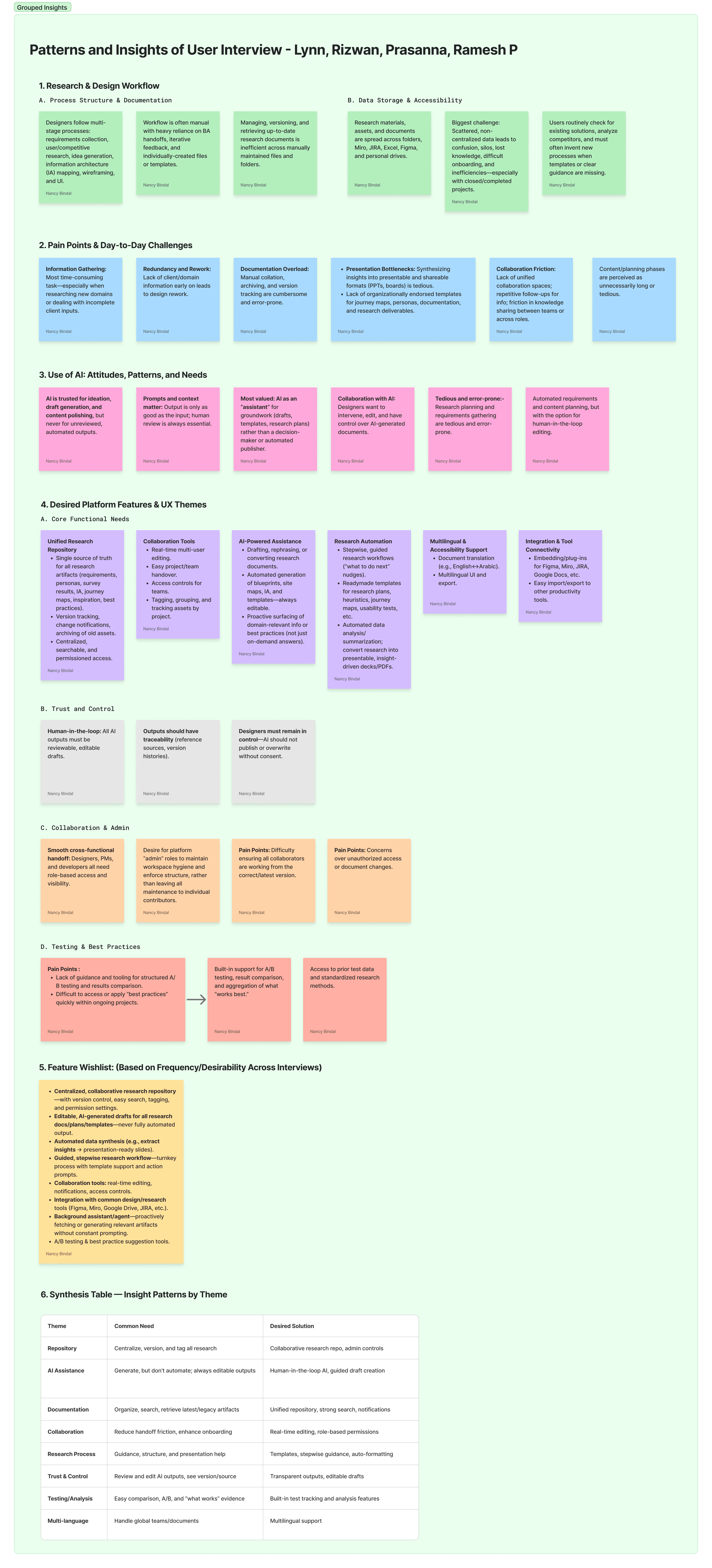
Six themes emerged consistently across all interviews - not as isolated complaints but as a connected system of friction.
Fragmented knowledge, no continuity
Trust is the central barrier to AI adoption
AI as collaborator, not decision-maker
Research is invisible until it becomes a prototype
Onboarding and handover are broken
Templates are survival strategies
What We Were Testing
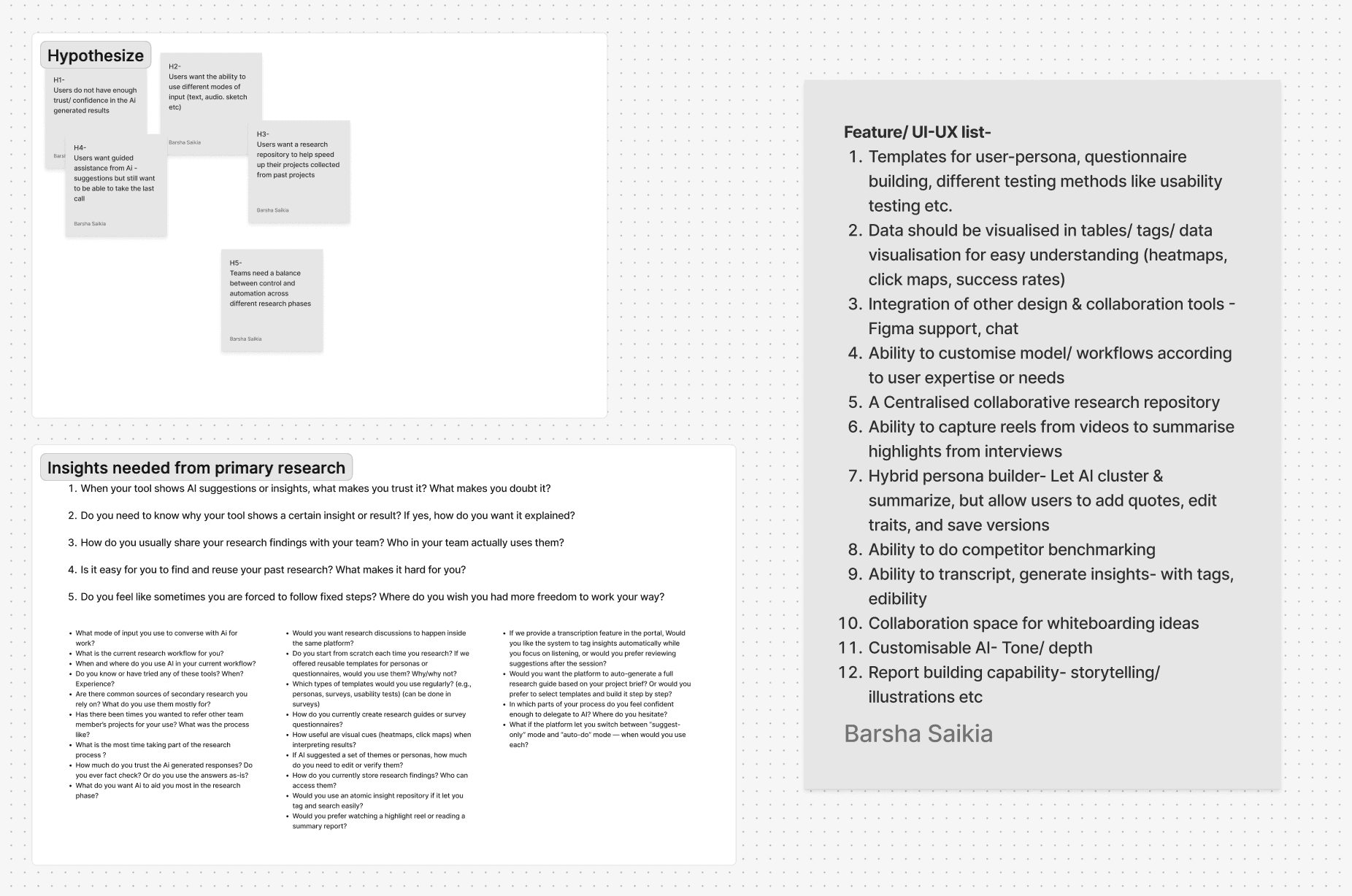
Before synthesis, we articulated five hypotheses drawn from secondary research and early interview signals. These became the lens through which we evaluated everything we heard.
H1 — Users do not have enough trust or confidence in AI-generated results
H2 — Users want the ability to use different modes of input — text, audio, sketch
H3 — Users want a research repository to help speed up their projects collected from past work
H4 — Users want guided assistance from AI but still want to be able to take the last call
H5 — Teams need a balance between control and automation across different research phases
WHO WE DESIGNED FOR
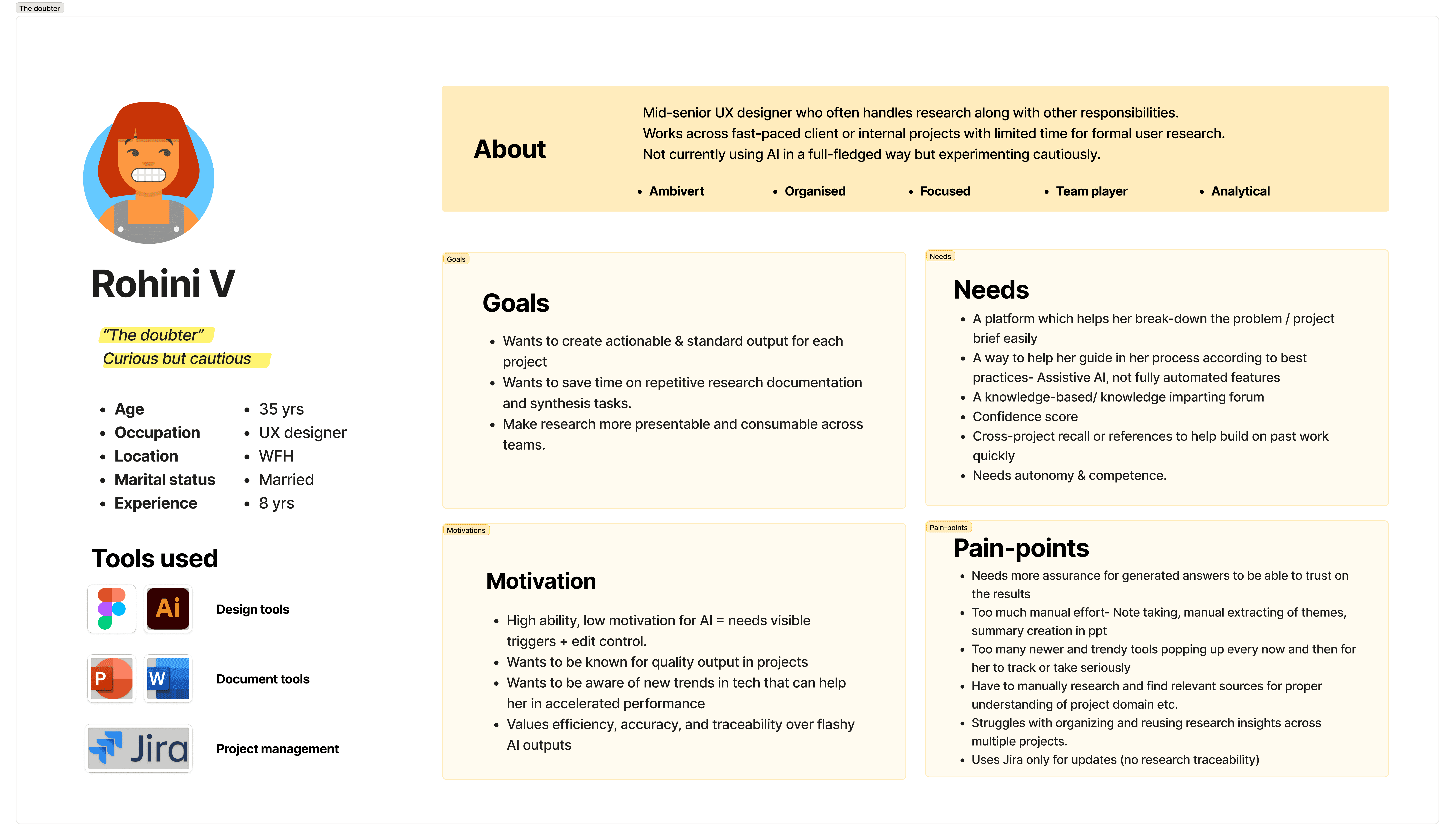
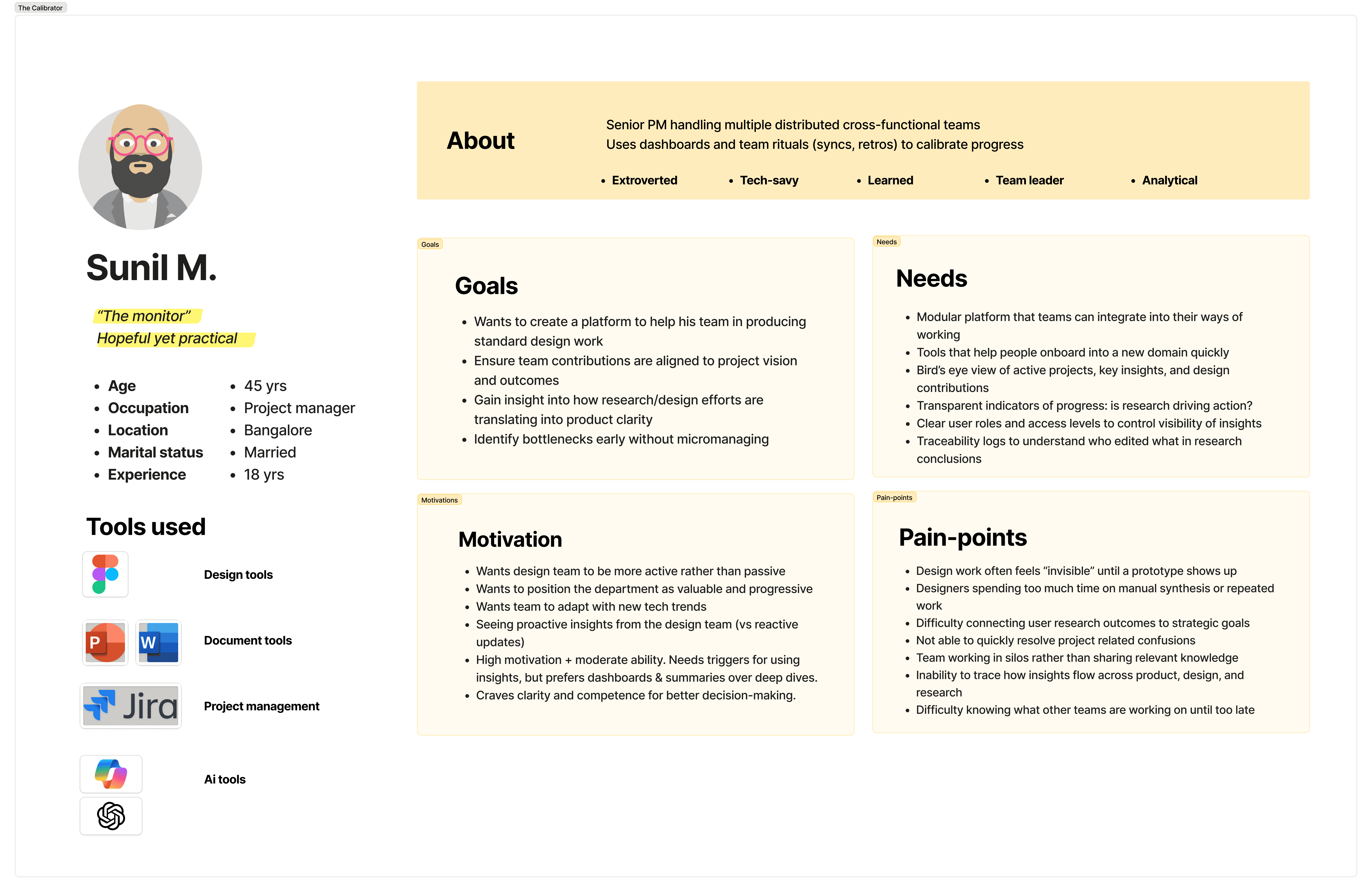
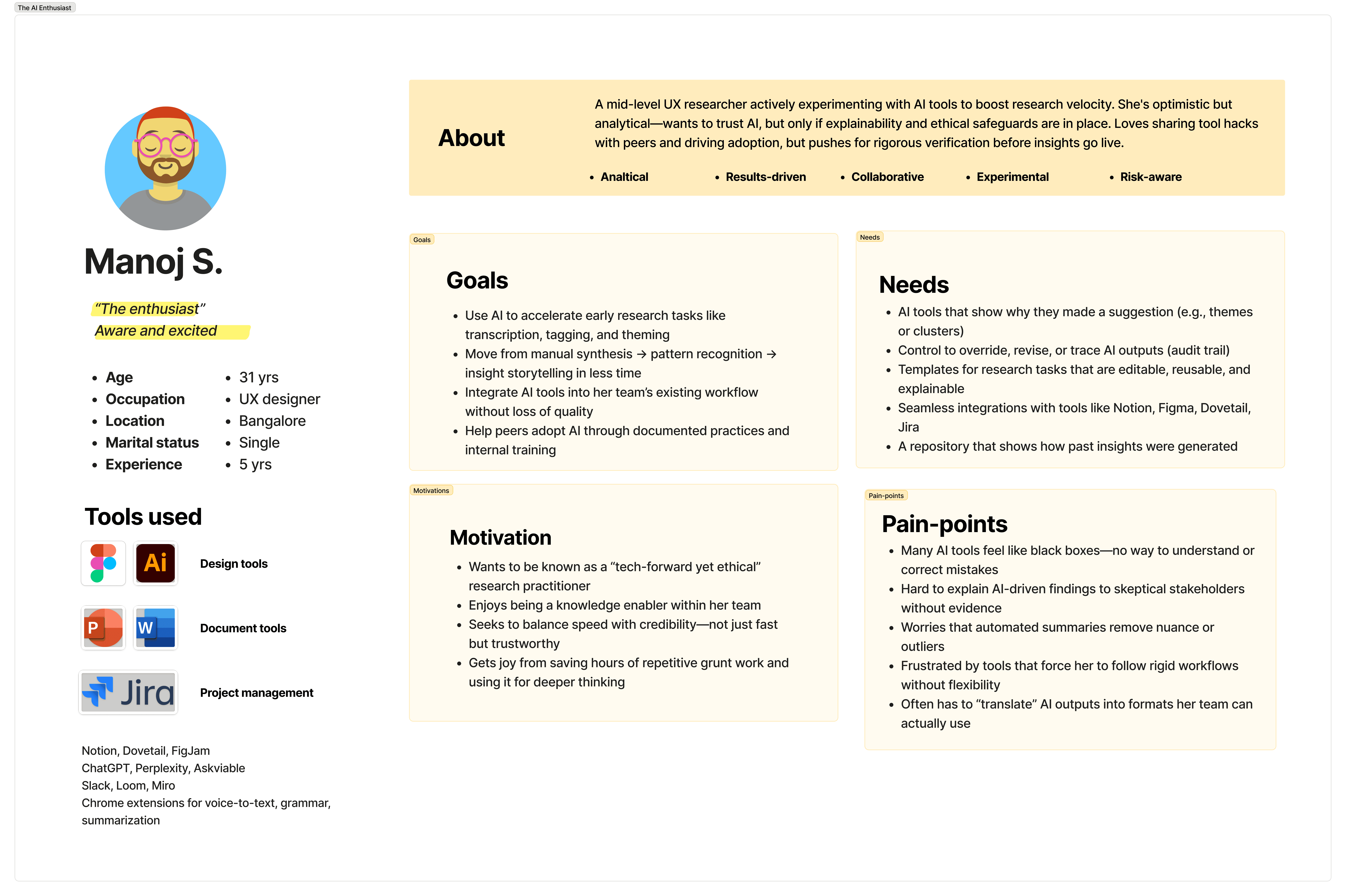
Three distinct personas emerged - defined not by job title but by their relationship with AI and research uncertainty.
From How Things Are to How They Could Be

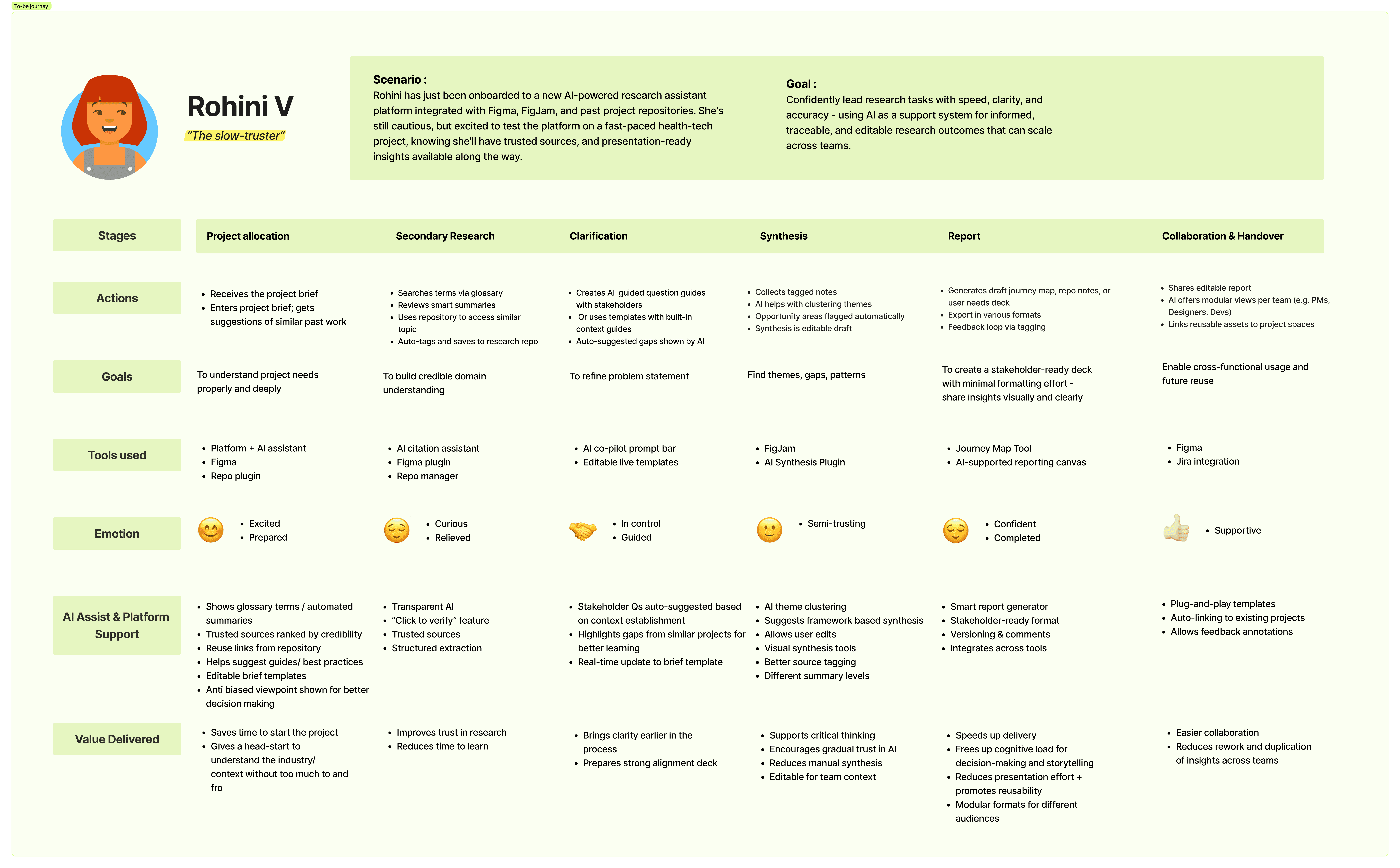
For each persona we mapped the as-is journey - the real friction, the workarounds, the emotional cost of the current state - and the to-be journey - what the same workflow looks like when Thread intervenes at the right moments.
The to-be journeys include an AI Assist & Platform Support row that shows specifically where and how AI should intervene - and critically, where it should stay out of the way.
The to-be journey isn't about replacing the researcher's judgment. It's about reducing the cost of using it well.
THE OPPORTUNITY SPACE
From Insights to Strategy
Across secondary research, survey findings, six designer interviews, and the programme manager interview, we mapped over 50 opportunities.
These were clustered into eight strategic feature themes through a synthesis workshop with the full team and senior stakeholders.
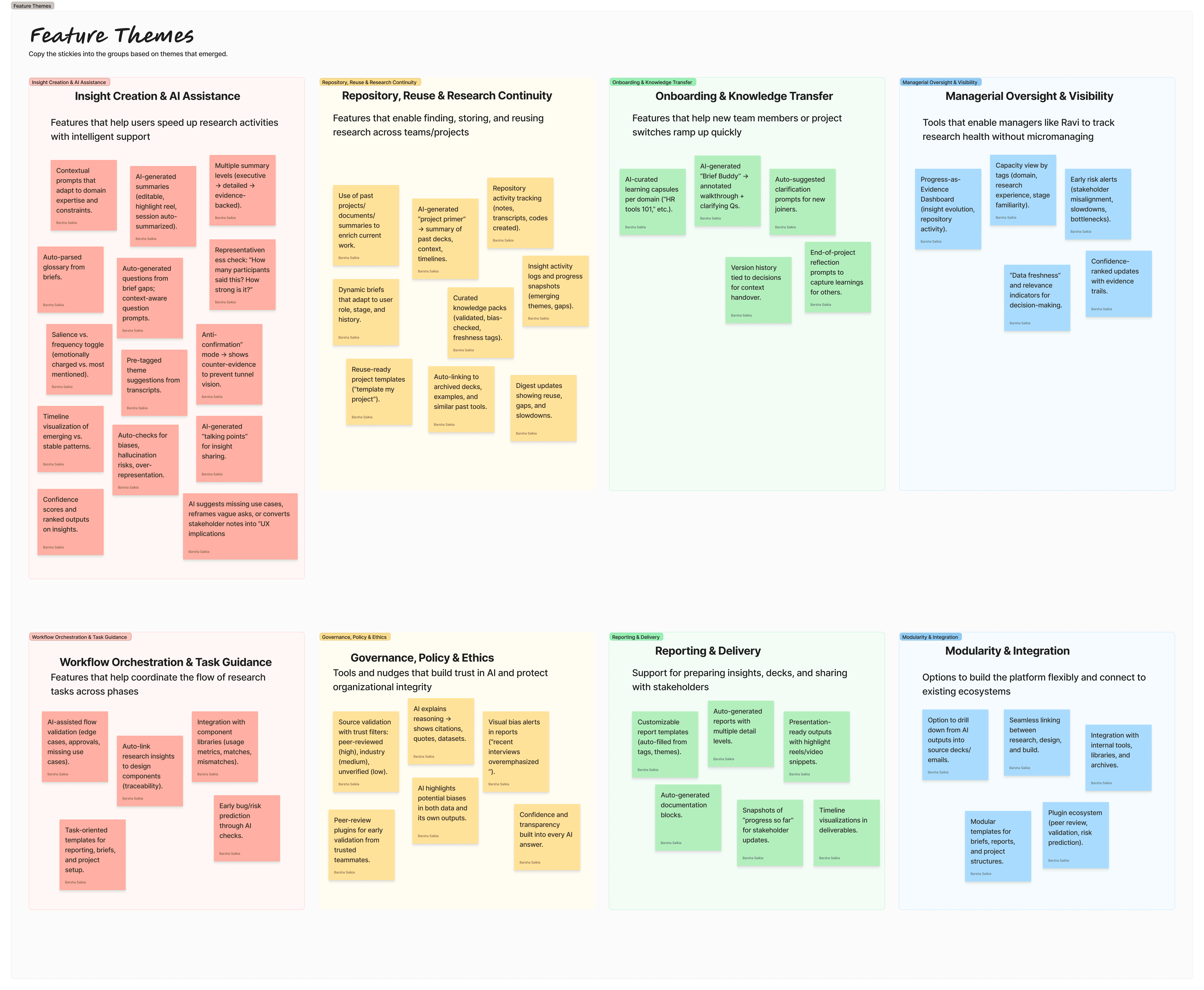
Each feature was scored across three dimensions - impact to user and business, feasibility to build in the current phase, and strategic differentiation in the market.
This wasn't just a ranking exercise. It was a structured conversation about trade-offs that forced the team to align on what mattered most and why.
Explainable AI outputs
Every insight should show why it was generated, with the ability to edit or undo. Impact: 4/5. Strategic Differentiation: 4/5.
Research repository with cross-project reuse
Centralised, versioned, searchable. Impact: 4/5. Feasibility: 3/5.
Human-in-the-loop design
Mode switching between auto, assist, and manual at every research stage. Impact: 4/5. Strategic Differentiation: 4/5.
Onboarding and handover support
AI-generated project primers that bring new team members up to speed without manual handholding. Impact: 4/5. Feasibility: 4/5
Managerial visibility
Progress-as-evidence dashboards that make research momentum visible without requiring managers to read the research. Impact: 3.5/5. Strategic Differentiation: 4/5.
The Principle That Guided Everything
"AI should reduce the cost of good research -
not replace the conditions that make research trustworthy."
If a feature automated insight generation without showing its reasoning -
it failed the test. If it removed a step that required human judgment - it failed the test. If it made research faster at the cost of making it less defensible - it failed the test.
The most trusted AI tools, as the survey and interviews consistently showed, are the ones that make their reasoning visible and keep humans in control of the conclusion.
THE LESSONS
Reality Check
The project was moving toward implementation blueprint definition when it was deprioritised due to internal restructuring.
A reality of large organisations that anyone working in AI adoption will recognise - good strategic research sometimes get shelved because organisations lack the right moment and the right champions to act on it.
This taught me something more valuable than any deliverable we produced:
Strategic research that doesn't get embedded into organisational decision-making at the right moment doesn't fail because of its quality.
It fails because building champions for the work is part of the research strategist's job - and it's the part that happens in rooms, not Miro boards.
If I were doing this again, I would bring the opportunity mapping into a shared workshop with senior stakeholders much earlier - before the prioritisation phase, not after it. Make the trade-offs visible when decisions can still be influenced.
Learnings
What I'd do differently
Involve senior stakeholders in synthesis, not just as recipients of findings. Decision-makers need to feel the research, not just read it.
What the research proved
Trust in AI is not a technical problem. It's a design problem. Every person we spoke to was willing to use AI - they just needed to be able to see inside it.
What I'm carrying forward
Every AI product I work on now starts with the same question: where does this remove human judgment that should stay human? That question came directly from this project.
What This Work Produced
✦ A validated strategic research foundation for an AI platform - ready for implementation blueprint development
✦ Three fully developed personas with as-is and to-be journeys, each validated against primary research
✦ 50+ opportunities mapped, clustered into 8 themes, and prioritised across impact, feasibility, and strategic differentiation
✦ Survey data establishing that 0 out of 17 designers trust AI outputs without editing - a finding with direct implications for any organisation adopting AI research tools
✦ A design principle - AI as collaborator not decider - that applies beyond this project to every AI product in the research and knowledge management space
The knowledge exists in most design teams.
Thread was an attempt to make it accumulate.